Ask how many locks are on the Trent-Severn and you will get 44, 45, or 43, usually from people who are all certain and all reading the same signs. The waterway’s highest lock number is 45. Parks Canada says 44. Count the chambers that actually hold water and you get 43. Count the places you physically stop the boat and it drops to 42.
Nobody is lying. The number changes depending on what you decide a lock is — and the disagreement turns out to be the more interesting answer.
Start with the official number: 44
Parks Canada’s own navigation data is unambiguous. 44 locks. 42 lock stations. 386 kilometres, or 241 miles, from the Bay of Quinte to Georgian Bay. Highest lift 19.8 metres — 65.4 feet — at the Peterborough Lift Lock.
That is the number to use if someone asks you at a bar. It is also the number that immediately raises two questions, because the locks run from 1 to 45, and 44 locks at 42 stations means two of them are hiding somewhere.
Lock 29 does not exist, and it is not a mistake
Run the numbers along the waterway and you count up to 28 — and then jump straight to 30. There is no Lock 29. Not closed, not seasonal, not a side channel. It is simply not there.
Burleigh Falls was built between 1882 and 1887 as a flight — two chambers stacked back to back, lifting boats in two stages. The lower chamber was 28 and the upper was 29. In 1967 the pair was replaced with a single concrete lock doing the whole job in one go, and Parks Canada’s own record puts it plainly: the rebuild eliminated the number 29 from the system.
They did not renumber everything downstream, which would have invalidated every chart, sign and guidebook in existence. They just left the gap. Fifty-odd years later, Lock 28 still lifts you 24 feet in one chamber and the number 29 is still missing, and the only trace of it is a hole in the sequence.
So: 45 numbers, minus one deleted, equals 44 locks. That is where Parks Canada’s figure comes from.
Then 44 locks turn out to sit at only 42 places
This one is not a deletion. It is two pairs of locks sharing a single site.
At Ranney Falls, locks 11 and 12 are a flight — the same arrangement Burleigh Falls used to have. You enter the lower chamber, rise, and the upper gate opens directly into the next chamber. You never leave. One stop, two lockages, two numbers.
The same thing happens again at Healey Falls, where 16 and 17 are a flight. And note the trap: there is also a Lock 15 at Healey Falls, a separate single chamber a short distance away. Healey Falls has three lock numbers and two stops.
Do the arithmetic and it closes exactly. 44 locks, minus the two flight pairs that each occupy one site, gives 42 lock stations — precisely the figure Parks Canada publishes. The two numbers were never in conflict. They were counting different things.
And one of the 44 is not a lock at all
Here is where the definition stops being administrative and starts being physical.
Lock 44 is the Big Chute Marine Railway. It is numbered as a lock, listed as a lock, and counted in the 44. It has no chamber, no gates and no water. A carriage runs down into the river, you float on, slings take the hull, and your boat is carried over a granite ridge on rails — 58 feet, about seven minutes, entirely out of the water.
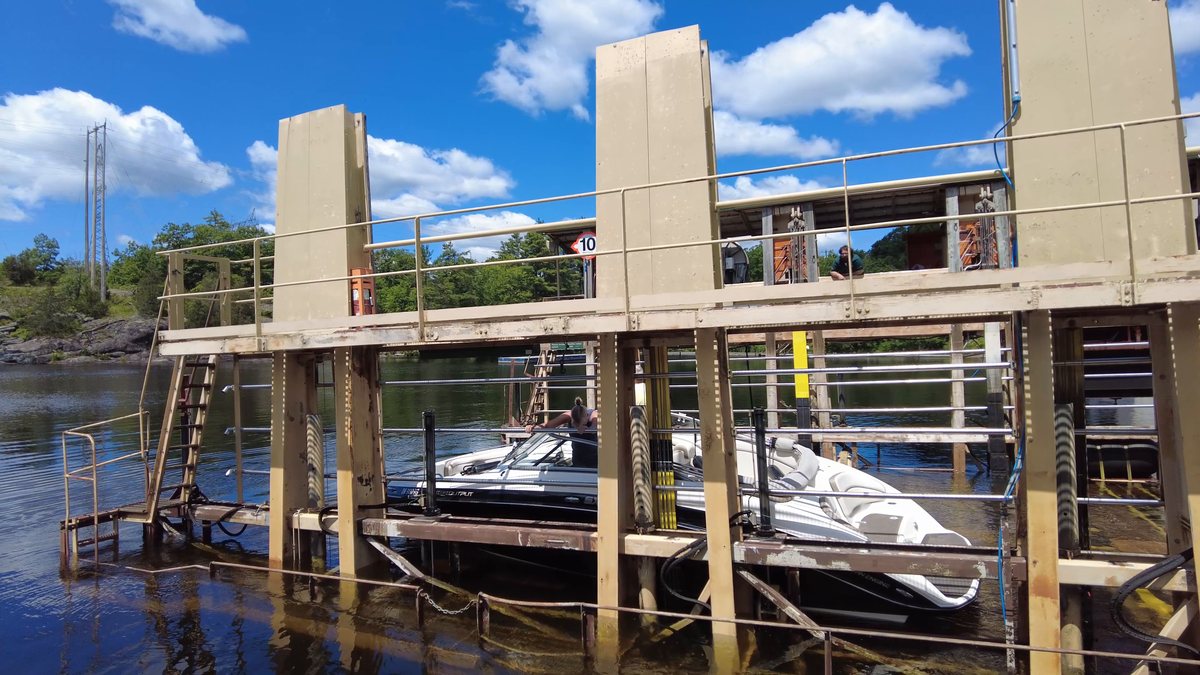
Nothing else on the waterway asks your vessel’s weight. Big Chute does, because it is lifting you rather than floating you: 100 feet of length, 24 feet of beam, 99 tonnes.
If your definition of a lock is “a chamber that fills and empties,” then the Trent-Severn has 43, and Lock 44 is a very large piece of railway with a lock’s number painted on it.
The one that most people never use
One more wrinkle, and this one catches people planning a transit rather than counting for fun.
Lock 33 at Lindsay is not on the through route. It sits up the Scugog River on a branch, and a boat running Trenton to Georgian Bay passes it by without ever seeing it. It is a genuine lock, fully counted — but if you transit the whole waterway end to end, you will not lock through 44 chambers. You will lock through 43, and one of those is a railway.
Why Great Loop crews ask this first
Most people asking the question are not settling a bar argument. They are planning, and a large share of them are running the Great Loop — the Trent-Severn is the Canadian leg, and for many Loopers it is the single most lock-intensive stretch of the entire circuit.
If that is you, the useful number is not 44. It is how many lockages you will actually perform, because that is what sets your days.
End to end, that is 43 — the 44 minus Lindsay, which you will not visit — and one of those 43 is Big Chute, which behaves like nothing else on the route. Two of the remaining chambers are flights, so at Ranney Falls and Healey Falls you will do two lockages back to back without leaving the site. Budget those as one stop and two cycles.
AGLCA members comparing notes on transit times are usually comparing different things without realising it: someone who counted 42 stops and someone who counted 44 locks will produce very different day plans from the same waterway. Agree which number you are using before you compare schedules with anyone.
The water levels page matters more to that plan than the lock count does, incidentally — a shallow year changes your route options far more than an extra chamber changes your day.
So what do you tell people?
Use 44. It is Parks Canada’s number, it is the one on the signs, and it is defensible.
But the honest version is a short ladder, and it is worth knowing which rung you are standing on:
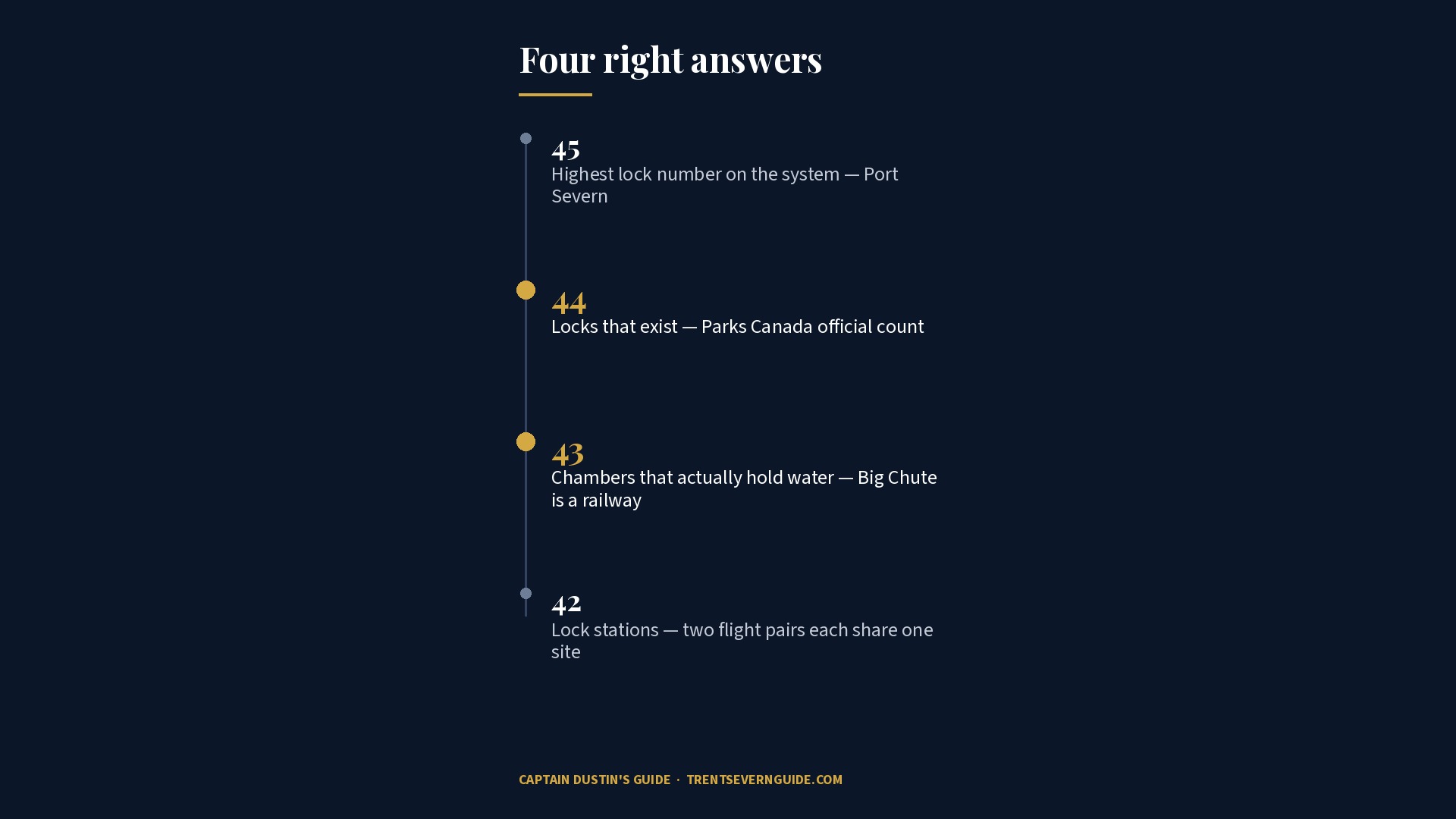
- 45 — the highest lock number on the system, at Port Severn
- 44 — locks that exist, after 29 was deleted in 1967
- 43 — chambers that actually hold water, once Big Chute is excluded
- 42 — lock stations, because two flight pairs each share one site
Four numbers, all correct, none of them contradicting each other. The waterway was built in pieces over generations, by people solving local problems in whatever order the money arrived, and the numbering carries every one of those decisions like rings in a tree — a deleted lock here, a doubled-up flight there, and a railway wearing a lock’s number at the far end.
Which is a better answer than 44, and considerably more fun at the blue line.
Every station is documented individually in the lock directory — lift, chamber dimensions, gate type, hazards and current operating status for all of them, including the one that is a railway and the one that is a side trip.
Sources
- Parks Canada — Trent-Severn Waterway technical data (44 locks, 42 lock stations, 386 km, highest lift)
- Parks Canada — Lock 28, Burleigh Falls (1882–1887 flight lock; 1967 single-chamber replacement eliminating number 29)
- Lock numbers, gate types, lifts and dimensions from this guide’s own station records.