Ask around the blue line at Big Chute and you will hear two explanations for why the only operating marine railway in North America sits where a lock ought to be. One says the granite ridge was too steep and too hard to cut. The other says the railway is deliberate — a dry gap in the waterway that stops sea lamprey from reaching the inland lakes.
Both stories are in circulation, and the second one is usually told as the reason the thing was built. The dates make that impossible. The railway went in during the First World War. Sea lamprey did not reach these waters until twenty years afterward.
The honest answer is that it was built for the geography and a world war, and kept for the lamprey. Those are two different decisions, separated by a generation, and collapsing them into one is what makes the common version wrong.
What actually stopped the locks
Parks Canada’s own record for the lockstation is blunt about the origin. In 1914 contracts were awarded to build locks connecting the Severn River to Georgian Bay, and Lock 44 was one of them. A conventional chamber was the plan, not an afterthought.
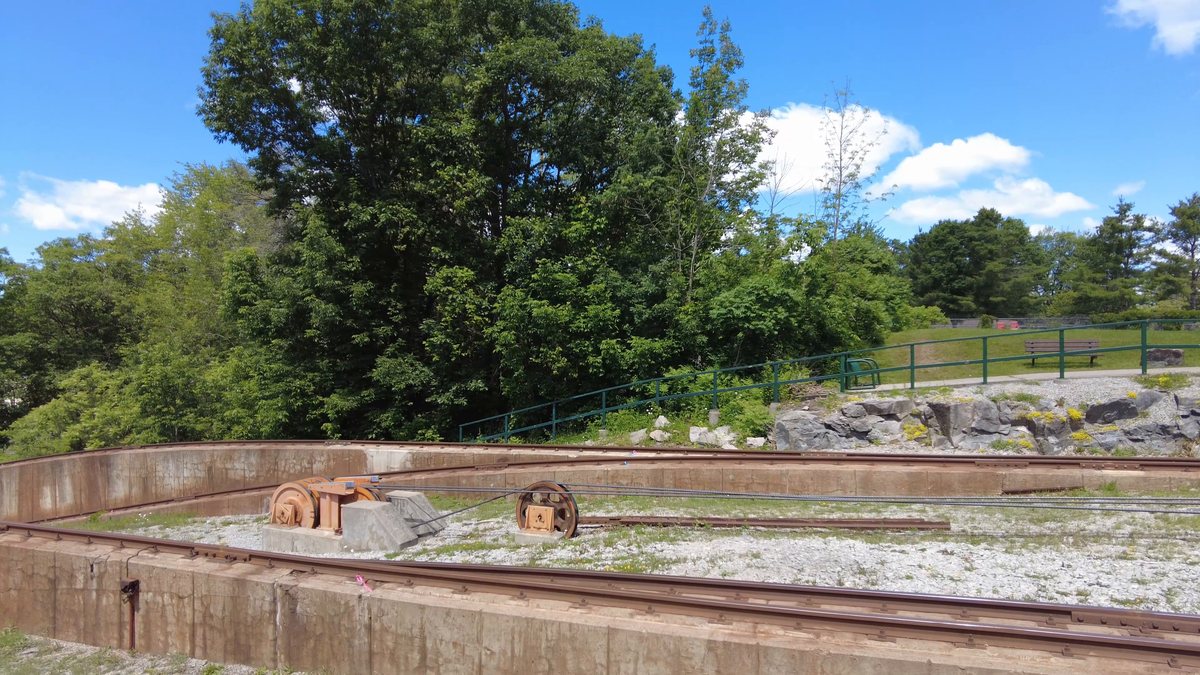
Then the war took the concrete and the men. Wartime shortages delayed construction, and rather than leave the Severn severed, the department put in a marine railway instead. It was a stopgap. Parks Canada lists the structure’s construction dates as 1917, 1923 and 1978 — the original, the replacement that followed when boats outgrew it, and the carriage in service now.
Nothing in that sequence involves a fish. The ridge at Big Chute is real, and a lock there would have been expensive, but the waterway is full of expensive solutions to hard geography. Thirteen kilometres upstream at Swift Rapids the same river drops 47 feet and Parks Canada built a conventional chamber anyway. Big Chute got a railway because of when it was built, not only where.
The lamprey arrived twenty years too late to explain it
This is the part that settles the argument, and it is worth getting the dates right because they are widely misquoted.
Sea lamprey were recorded in Lake Ontario as early as 1835. Niagara Falls held them there. When the Welland Canal was reconstructed in 1919, that barrier came off, and the Great Lakes Fishery Commission traces the spread from there: Lake Erie by 1921, Lake Michigan in 1936, Lake Huron in 1937, and Lake Superior in 1938.
Georgian Bay is Lake Huron. The marine railway was carrying boats over the ridge for two decades before there was a lamprey within reach of it. A structure cannot have been built to solve a problem that had not yet arrived.
You will see 1932 quoted for Lake Huron. That date belongs to the first recorded lamprey spawning run in Lake Erie, several hundred kilometres and five years short of the Bay.
Why it never got replaced
So the barrier argument is wrong about the beginning and right about everything since.
By the time anyone could seriously revisit the question, the railway had become something the original engineers never designed: a stretch of the waterway where a hull leaves the water entirely. A lamprey riding a hull does not survive an overland transit. Parks Canada states plainly that the current marine railway, opened in 1978, has been instrumental in halting the spread of sea lamprey to inland lakes.
That is the agency’s own language about its own structure, and it is the strongest form of the claim that can actually be sourced. What is not documented anywhere I can find — not on Parks Canada’s site, not through Fisheries and Oceans, not through the Great Lakes Fishery Commission — is the specific meeting where someone chose the railway over a lock for that reason. That story circulates widely, usually pinned to the 1960s rebuild. It may well be true. It is not sourced, so it is not stated here as fact.
What can be said is this: a temporary wartime measure turned into a permanent one, and somewhere along the way its accidental side effect became its most valuable property.
What the history means on your boat
The reason any of this matters at the helm is that Big Chute does not behave like the other forty-something stations on the system, and the reason it does not is the reason it exists.
There is no chamber. The carriage runs into the water, you float on, and slings take the hull. The transit over the ridge takes about 7 minutes and lifts 58 feet — 17.68 metres — at kilometre 374.1, near the Georgian Bay end of the run. It is on CHS chart 2029-1.
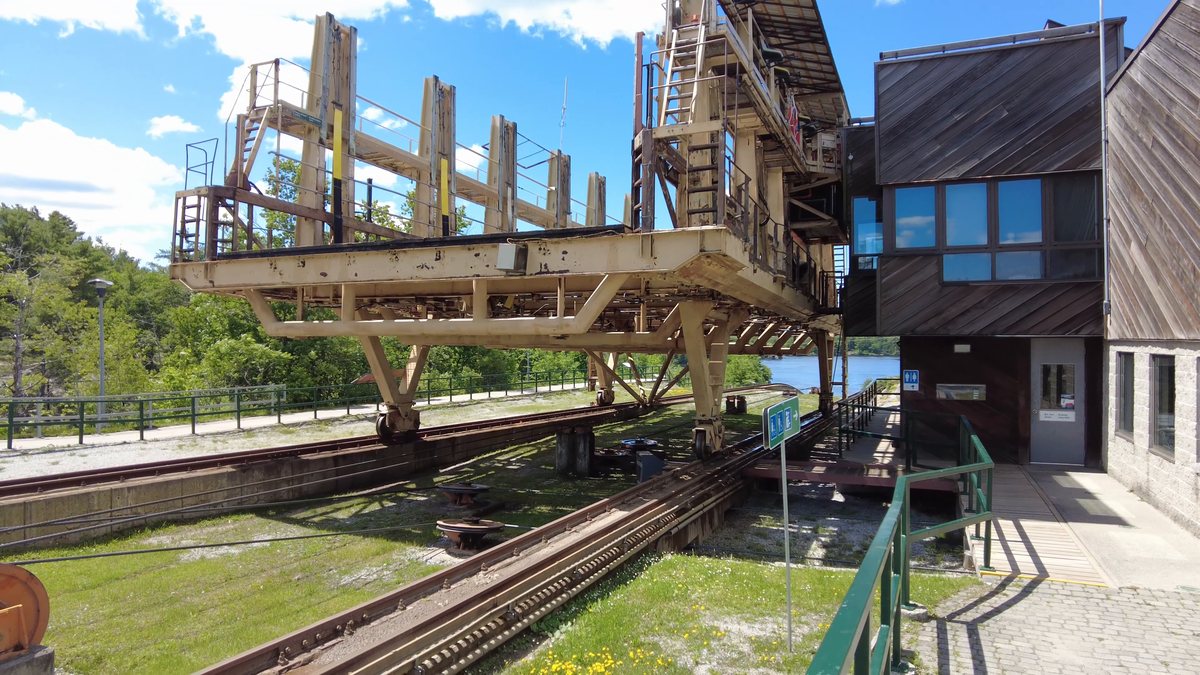
The limits are the carriage, not the water:
- Length 100 feet, beam 24 feet. This is a physical cradle, so beam is a hard stop rather than a comfort question.
- Maximum weight 99 tonnes. No lock on the system asks you this. The railway does, because it is lifting you rather than floating you.
- Maximum draft 6 feet, consistent with the rest of the waterway.
Two procedures catch people, and both come straight from the fact that the boat is being lifted:
Remove every fender before loading. Nothing may hang below the hull’s centreline. On a lock wall a dangling fender is untidy; on the carriage it is between your hull and a steel frame.
You do not work lines at Big Chute. Keep them inboard. There is no wall to tie to and nothing to tend — the slings carry the boat, and the crew’s job is to stay put and stay clear. This is the opposite of the habit you build at every conventional chamber on the system, which is exactly why it is worth saying out loud before you get there.
Staff position every vessel on the carriage. Follow their directions exactly and immediately; they are managing load distribution across boats that may be sharing the ride with you.
The short version
The railway at Big Chute was a wartime substitute for a lock that was already under contract. It stayed because replacing it stopped being obviously worth doing, and it earned its permanence afterward, when a parasite that arrived in 1937 turned out to be unable to cross dry granite on the back of a boat.
Geography set the site. The war set the method. The lamprey settled the argument about whether to undo it.
Plan the stop accordingly — check the Lock 44 station page for current operating status before you commit to a run down the Severn, and confirm conditions on the water levels page if you are near the draft limit. Full station-by-station detail for the rest of the system is in the lock directory.
Sources
- Parks Canada — Lock 44, Big Chute marine railway (construction dates; sea lamprey statement)
- Great Lakes Fishery Commission — Sea Lamprey (invasion timeline)
- Vessel limits, lift, chart and kilometre marker from this guide’s own Lock 44 station record.